by The Cheltenham Group, HTML Edition 2.2, 1998
An outline of the effects of matrimonial law on men and fathers, with advice for young men,including a description of the lack of protection, persecution and human rights violations to which men are subjected,
as well as the personal and social outcomes.
The description is supported by case studies and statistics in chart form.
The Cheltenham Group, PO Box 205, Cheltenham, Glos., GL51 0YL
� The Cheltenham Group 1998
Disk Edition 1.0 first published in 1997
Disk Edition 2.2 in 1998 : ISBN 1 900080 06 0HTML Edition 2.2 1998
All rights reserved
For young men everywhere
It is necessary only for the good man to do nothing for evil to triumph
Attributed (in a number of forms) to Edmund Burke 1729-97,
Irish statesman and orator, who championed many human rights causes
1 The Basics : for those with limited time
2 The Outline : the law and its effects
2.1 Separation and ‘no fault’ divorce
2.2 Children
2.3 Financial matters
2.4 Damage to health and career
3 The Causes : how this situation came about
3.1 The origins of ‘no fault’ divorce
3.2 Women know they can do anything they wish
3.3 The judges, and others who should protect men
3.4 State support for lone mothers
3.5 Liberal attitudes and radical feminism
3.6 The inactivity of men
4 The Advice to Young Men : what you can do about it
4.1 Avoiding the issue
4.2 Going to law
4.3 Public relations
4.4 Political activity
5 The Conclusions : what must be done
References : for those who wish to study the subject further
Index - only available in hardcopy or disk format of book.
List of Figures
Preface
This book describes, for young men, some very important aspects of the state which for centuries has been known as ‘marriage’, but which has been changed beyond recognition during the second half of this, the twentieth century.
The Cheltenham Group (CG) is a specialist organisation which first met in April 1994 and which includes members from a number of other organisations such as Families Need Fathers (FNF), Dads After Divorce (DADs) and Parents Forever Scotland (PFS). The Group has studied and researched current practices in matrimonial and family law and has formulated family law policy which is supportive of the rights and responsibilities of men and fathers.
This study and research is focused on two main areas. Firstly, on the case histories of men and fathers subjected to matrimonial and family law. Secondly, on the law and its interpretation. Case histories have been made available from : the many men and fathers who have contacted the various groups and contributed to the vast amount of anecdotal evidence; those contacts who have carefully committed their substantial story in writing and supplied this to the Group; a major survey conducted during the summer of 1995 of members of the largest fathers’ group Families Need Fathers (FNF). This last source provided information from 346 respondents out of the then 1500+ members of FNF who were all canvassed. This information includes brief case studies, and importantly detailed information about the process and consequence of divorce, that is about the legal process and about the consequences regarding children, home, life savings and the on-going situation. The case studies have been categorised, and the detailed information analysed to present a picture not previously available. A knowledge of the development of the law and its current interpretation has been obtained through study by a number of informed individuals, assisted by concerned lawyers, until an overview has been obtained.
The 1995 survey information is open to the criticism that it is based on a biased sample, that since the respondents were moved to join a fathers’ group (FNF) they must represent an atypical minority. We assure the reader that such accounts are typical of those given in the vastly greater number of calls to the Group, to FNF and other groups, by men who do not take up membership, including calls made during and after Cheltenham Group broadcasts. There is growing and undeniable evidence that these cases are typical and widespread.
The full analysis of the data is presented in other Cheltenham Group publications listed in the references, and this book uses a selection from the case studies and statistics to support the aim of educating the public, and among other things to ensure that young men have appropriate information to hand when making decisions about their life and future
In addition to the description of the process and consequence of divorce, it is necessary to provide an understanding of why and how this situation has arisen. The recent changes in matrimonial law have been introduced, not through the usual democratic process of the public writing to MPs and requesting improvements, but by ‘backdoor’ methods in which the public was never consulted, and not even informed. It is important that the public at large comprehend this in order that the future development of the law should be in accordance with the wishes and beliefs of ordinary decent people.
Further, we describe the steps that young men may take in order to protect, so far as is currently possible, their legitimate interests from unwarranted attack.
It is believed that the information we present, being ‘politically incorrect’ and consisting of politically embarrassing, unfashionable truth, has previously been neglected by academics and other social researchers and is being presented here by the Cheltenham Group for the first time.
The message of this book is unpleasant, but the Cheltenham Group believes that it is necessary to state the hard truth for genuine reform to be possible and it must be realised that we deal not just with personal complaints of unfairness but with problems which are literally destroying our society.
The Group acknowledges the courage of men who are at last speaking out against this situation and thanks especially those men who have contributed accounts of their own painful experiences to the cause of restoration. For them and for future generations we present our report.
Young men are entering marriage and fatherhood, quite reasonably, under the impression that in so doing they are acting honourably towards their chosen wives and responsibly undertaking the duties of fatherhood. They therefore assume that the law will support their commitment and that, by marrying they acquire, along with willingly accepted responsibilities, recognised rights which are defensible in law. In short, young men assume that, apart from a few concessions to ‘women’s rights’, marriage remains substantially the same institution on which every human civilisation has been based.
Tragically, both for individuals and for our society, these assumptions are a na�ve illusion and in reality the man who marries is placing himself in severe personal danger of finding his life ruined by the loss of all that he has worked for and loves, his home and children, and a large part of his income in a divorce he neither wanted nor caused, which he was powerless to prevent and in which his basic rights had no legal support whatsoever.
In this booklet we try to impress upon all readers but upon young men in particular the stark truth about the damage which has been inflicted on marriage and hence the great danger in which this places them. We give a summary of the situation for those with limited time and then illustrate the claims with research results obtained by the Cheltenham Group of a sort hitherto suppressed by the vested interests of the divorce industry. The results reveal the full appalling scale of the political, judicial and professional corruption which is destroying the true two-parent family with social consequences that are only too familiar. Our intentions are that young men will then be able to make an informed choice as to whether to risk marriage or opt for a safer alternative pending true reform, and hopefully, that all decent men and their supportive womenfolk will be encouraged to fight with the Cheltenham Group and its allies for truly radical reform to restore the legal institution of marriage. We make our case as active supporters of true marriage and we do not detract from its positive aspects which rightly attract young men. We refer to the negative consequences of divorce, the damage to a man’s life which is the usual result.
Most young men have little or no knowledge of the effects of divorce. A few may have experienced the divorce of their father, or perhaps an older brother. But even in these situations, the full story is often not conveyed to the immediate family, and especially to young children. There are various reasons for this, mainly connected with the distress and trauma involved. In adulthood, when a man may meet many other men as work colleagues, at the sports club, and so on, those men affected by divorce are usually very reluctant to describe the reality of their case. Again there are various reasons for this, mainly a result of men’s pride and their reluctance to admit to their friends that they have suffered in any way.
But we also have a culture in which this information is suppressed. The culture is liberal and usually feminist, and therefore is anti-men. To illustrate this, we can consider typical terminology. Let’s take the commonly used phrase ‘the marriage broke up’. We note that a marriage is an arrangement between two people, and so it requires one of the two to cause the ‘break up’. Similarly a mortgage is an arrangement between one or more people and a building society : the mortgage may be terminated by either party, but only under the reasonable rules laid down for that. No one would ever say ‘the mortgage broke up’ - that would be a ludicrous, and semantically meaningless statement. But we can no more have a marriage ‘breaking up’ than we can have a mortgage ‘breaking up’, hence the phrase conceals the real situation. Similarly the phrase ‘absent father’, which implies wilful abandonment, is used to obscure the reality, which is that most fathers are excluded. It is true that some fathers are wilfully absent, but the word ‘absent’ is applied to all such fathers, even in the written law. In considering the effects of the use of such phrases, you should bear in mind that 72% of divorces are instigated by the woman, yet the phrases are anti-men.
So we have ignorance about the effects of divorce. But the scale of these effects is also unknown to most people. It is true that most people know there is a high divorce rate in the UK. In fact, the 1993 Government data, gives the rates per thousand of population : marriage 5.9, divorce 3.1. That is there were 52.5 divorces for every 100 marriages, giving a failure rate of 52.5%. But most people do not know the statistics for the effects of divorce. This is because, until recently, no one, either the Government, or the Lord Chancellor’s Department, which is responsible to the Government for the law, or the Central Statistical Office, or any other body, had measured them. That situation was largely remedied when, in 1995, members of the largest UK fathers’ group, Families Need Fathers, were surveyed. With, at the time, 1,500+ members, a survey of this group, while not necessarily consistent with all of the UK population, nevertheless provides hard information about the effects. We are able to provide key information from the survey in this book.
While working on the report The Impact of Divorce Law Practice on Fathers and Children - The Main Findings and the - Supplement : Summary, Probabilities and Extrapolations, and Conclusions, July 1996 [1], which presents the survey findings, and on the book The Emperor’s New Clothes : Divorce Process and Consequence, October 1996 [2], a large number of case studies, written in the man’s own words, became available. Examples from these case studies are included to provide a vivid insight into the realities of divorce as experienced by these men. The report [1] is given in Annex 3 of the book [2].
Being primarily addressed to young men, this book gives essential information about :
the possible future behaviour of their chosen wives;
the legal process of divorce, which takes place within a comprehensively corrupt legal system;
the effects on individuals, with examples from the available case studies;
and the scale of this, with statistics from the 1995 survey, previously unavailable.
As well as helping us to achieve our aims as stated above, this booklet therefore also indicates courses of action to avoid and how to deal with problems as well as activities in public relations and the political arena.
To confirm the validity of the information given, we provide :
in section 1, quotations from the summary of the report [1] ;
in sections 2 & 3, quotations from the case studies in the book [2] ;
and also in sections 2 & 3, statistics in chart form, with their original references, from Annex 3 of the book [2].
All quotations from case studies are given "in italics", and full copies of the case studies are available in the book [2]. The most significant statistics are given here mainly in chart form, and more comprehensive statistics are also given in the book [2]. It should be noted that the number of cases given in the charts, are number of cases out of the 346 respondents in the survey, but it should also be noted, that it must not be expected that the issue in each chart is relevant to all respondents. The charts primarily show proportions of outcomes rather than absolute numbers. For certain outcomes of divorce, section 1 includes estimates of both the probability of that outcome, and an estimate of absolute numbers in the UK, with the estimates based on extrapolations of the probability onto the population.
It is not the intention, necessarily, to prevent young men from marrying. That would remove a major component from the fulfilment of their lives. However, the situation which young men now face is very hazardous. Young men need the information in this book to direct their lives, in an informed way. If you, the reader, are not a young man, you should also read this book. Whichever category you may be, if you agree that there is an issue here which needs to be addressed, you should then consider the implications of this information for the young men known to you, and for our society. If you are concerned, you must then act to remedy this situation.
What is this all about, and why should I read it ?
The Cheltenham Group, which speaks for men on family matters, exists to protect the interests of men within the family. The message of this book is specifically addressed to young men, to inform those who may be considering marriage and fatherhood, of the realities of life.
You should read this because it gives you some essential information about marriage and fatherhood which is not available elsewhere. It is information of the utmost importance to you if you are to avoid some very serious damage to the fabric of your life. This concerns your future control over your children, your home, your life savings, your pension, your health, and your liberty.
What are the consequences of marriage and fatherhood ?
They are very often extremely serious, and far more often than most people realise. In this section we quote you extracts from the summary of the statistics report of the recent survey of members of Families Need Fathers, The Impact of Divorce Law Practice on Fathers and Children - The Main Findings, and the - Supplement : Summary, Probabilities and Extrapolations, and Conclusions, July 1996 [1]. The extracts are given "in italics".
In this age of equality, I have equal rights over my children, don’t I ?
You have almost no rights that you can rely on to be upheld by a court. As the report says :
"After the cases, about 80% of women had custody of all their children. In more than 80% of cases, the man reported some obstruction to contact. Nearly 30% of fathers had lost all contact with their children, and more than 30% reported the mother as being in contempt of a court order. No mothers had been prosecuted for contempt."
If I have difficulty seeing my children, surely I don’t have to pay maintenance ?
These issues are entirely unrelated in law. There are a large number of men who are forced to pay maintenance, even when they never see their children.
"More than 50% of men paid maintenance for their children, and nearly 15% paid maintenance for their ex-wife. The median amounts were over �200 per month for the children, and over �300 per month for the ex-wives. Maintenance had a median value of about 20% of earnings. Most court order amounts were paid, while many Child Support Agency (CSA) derived amounts were being challenged."
But the courts would protect my home, life savings and pension surely ?
Your home, life savings and a share of your pension are, after the children, the next target for your ex-wife, and the courts will ensure she gets most of what she wants. The lawyers will also want a share of your life savings to pay for their ‘services’ to you.
"On average, the man brought 5 times as much asset value into the marriage as the woman. During the marriage, the man on average earned 4 times that which the woman earned. On average the woman obtained, after the divorce, 5 times as much of the family assets as the man. The women, as a group, obtained nearly 80% of the families’ assets.
Legal costs had a median amount of about �10,000, with a range up to about �1,000,000. More women applied for legal aid, and more of those were granted it. The median financial loss to the family was about �50,000. Most homes were sold, although in those cases in which the home was not sold, the man more often stayed in that home. Women given the home nevertheless often sold it."
Since the survey results [1], the Pensions Act 1995 has been introduced, and this provides for pension splitting on divorce. Since then, you must share your pension as well as your life savings and future income.
Yes, but don’t men often ‘trade their wives in for a younger model’ ?
No they don’t. More than two-thirds of divorces involve the wife discarding a husband.
"The vast majority did not want their family to split up. None wanted to be separated from their children. Men were in most (over 70%) cases divorced by their wives, against their wishes. The grounds were predominantly unreasonable behaviour (nearly 60%) and adultery (nearly 25%). Most men denied the allegations made, and in those cases in which the man divorced the woman, few women denied the allegations."
Doesn’t this just happen to young, perhaps less well educated people, or soon after the first child is born ?
No it does not. Most divorces take place when men are in their prime, and children are young.
"The median duration of the marriages was about 10 years, and the respondents had a median age of 38 years of age at the start of divorce. The average number of children was close to 2, and their median age was over 6. The respondent’s occupations could be described as ‘middle-class’, although there was a great range of different occupations."
But if I employ a solicitor and a barrister, they’ll prevent this sort of thing won’t they ?
The legal system which interprets matrimonial law is comprehensively corrupt. Solicitors and barristers, as a body, earn a substantial part of their income from matrimonial cases. Most men, usually innocent of substantive wrongdoing, find themselves legally defenceless against the destruction of the fabric of their lives.
"Almost all respondents reported malpractices in their legal proceedings, with about 20% of these identifying solicitors, about 20% identifying Court Welfare Officers (CWOs), and about 20% identifying judges as responsible. About 50% of CWOs did not meet the fathers with their children, and about 66% of CWO reports were regarded as unfair. The majority of CWO reports, whether fair or not, were accepted by the judge.
About 80% of men reported false allegations against them, and about 60% reported non-compliance by the woman with court orders."
What do you mean by "the legal system which interprets matrimonial law is comprehensively corrupt" ?
We mean that those involved in the cases, i.e. solicitors, barristers, welfare officers, and judges are not doing their jobs correctly. Solicitors and barristers are failing in their duty of care to their men clients, welfare officers do not tell the truth in reports, and judges are ignoring the written law and Parliament’s intentions as to how the law should operate. If you find this hard to believe, then read the case studies and statistics in the book The Emperor’s New Clothes : Divorce Process & Consequence, October 1996 [2].
But surely, the Family Law Act 1996 will resolve these problems and allow settlements to be negotiated without acrimony ?
Nothing could be further from the truth. The FLA 1996 simply incorporates all the malpractices and illegal court rulings into statute law and adds a few more dangers making the situation worse than ever. The FLA removes the last vestiges of legal protection from husbands and, far from preventing ‘quickie’ divorces, it introduces what effectively are instant divorces. It may be true that a formal decree may not be issued for eighteen months but, by then, the husband will have been deprived of his children, home and a large part of his salary in a very short time in what is, in effect, an instant divorce. The ‘domestic violence’ provisions of this Act will give wives the power to have their husbands ousted from their homes without even an accusation of violence, but on a ‘balance of harm’ principle that the wife may be distressed by the man’s presence, without any notice of proceedings being necessary and on the most flimsy and arbitrary definition of violence. It is effectively an ouster on demand. Obviously the blackmail weapon of a marital ‘rape’ accusation, which requires neither proof nor even prosecution to achieve its effect will be much more powerful in these circumstances as has been discovered in the USA and elsewhere.
No, be assured that the FLA will make your situation significantly worse.
Don’t women need men for continuing financial support ?
No they don’t. There is massive state support for lone mothers from the benefits system, at a level which ensures that they may remain comfortably off without applying any effort in earning a living. And they need have no respect for the rights of the fathers of ‘their’ children. Also, taxation rules provide lone mothers with a higher net income, for any level of gross income, so that they are actually better off than a normal family. Further, there are benefits available to widows which are not available to widowers. All this provides women with a ‘lifestyle choice’ to go it alone or with a husband. This choice is not available to men.
I know that divorce couldn’t affect me so much
You’re probably incorrect if you think this.
"The vast majority of men reported health problems, usually stress related and also affects on career. Additionally, the vast majority reported negative attitudes against women and the law, with moderate to very strong views expressed."
But surely these things are comparatively rare ?
They are anything but rare. Most people know some man affected, although they may not have been told the whole story. We give here a selection of statistics from the report. The probabilities are out of 1, e.g. 0.53 means that this applies to 53% of the relevant population. The occurrences are those estimated from the probabilities, based on the assumption, and no better information exists at this time, that these probabilities apply to the whole population. The populations are those of all currently married men, and those divorced in one year.
| Outcomes: occurring to a married man during marriage Population : all currently married men |
P (outcome) |
Occurrences to currently married men |
| be divorced | 0.53 |
7,355,900 |
| be divorced by his wife using fabricated grounds | 0.24 |
3,338,800 |
| lose custody of his child(ren) | 0.24 |
3,417,800 |
| lose custody, and never see child(ren) again | 0.08 |
1,069,600 |
| lose his home | 0.39 |
5,516,900 |
| lose a significant part of his life savings | 0.49 |
6,923,200 |
| Outcomes: occurring to a married man during divorce Population : men divorced in 1 year |
P (outcome) |
Occurrences to married men per year |
| have no effective defence to a wife’s petition | 0.61 |
110,000 |
| not receive legal aid | 0.64 |
115,000 |
| have false allegations made against him | 0.58 |
105,000 |
| be the victim of malpractices in his legal case | 0.87 |
156,000 |
| Outcomes: occurring to a married man after divorce Population : men divorced in 1 year |
P (outcome) |
Occurrences to divorced men per year |
| suffer obstruction to contact with his children | 0.61 |
109,800 |
| suffers stress | 0.83 |
149,300 |
| will not remarry | 0.77 |
138,300 |
| have attitudes to women in general | 0.63 |
113,900 |
| have attitudes to the law | 0.90 |
162,800 |
| Item : of assets and legal costs at marriage and divorce Value : given in �s |
Average per case |
Total per year |
| transferred to women at marriage | 9,913 |
1,748,250,000 |
| transferred to women at divorce | 18,804 |
3,384,720,000 |
| paid to lawyers at divorce (men only data) | 29,306 |
5,275,080,000 |
| Item : of maintenance after divorce Value : given in �s |
Average per case per year |
Total per case (made over 10 years) |
%age of cases to which this applies |
Total for cases in 1 year (made over 10 years) |
| maintenance for children | 3,216 |
32,160 |
47.6 |
2,752,053,300 |
| maintenance for (ex-) wives |
5,292 |
52,920 |
13.4 |
1,276,430,400 |
It is possible to estimate the probability that a married parent will raise his or her own children, in a normal family setting, to adulthood. We have 47% of parents who raise their children within the usual two-parent family. For the other 53% who divorce, we know from the survey statistics that about 86% of mothers and only 9% of fathers will continue to have custody of all children. Taking 86% and 9% of the 53% who divorce, we obtain data about those divorced couples, that 46% of women and 5% of men retain custody. Adding these figures to 47% we obtain the figures that 93% of mothers and 52% of fathers will be primary carers responsible for raising their own children to adulthood. The probability that a married mother will remain a primary carer of her own children is therefore 0.93, but for a father the figure is 0.52.
Expressed in simple lay terms, if a man takes the step of marrying and has children there is :
a 50% chance that it will result in him losing his children,
a 25% chance of losing his home,
a 50% chance it will cost him about �82,320 (comprised of �53,014 to his ex-wife and �29,306 to lawyers),
and nearly a 50% chance he will not receive a full pension on retirement.
If a woman takes the step of marrying and has children there is :
almost a certainty she will keep her children,
a 25% chance of losing her home,
a 50% chance she will benefit by about �33,014 (comprised of �53,014 from her ex-husband but of which about �20,000 goes to lawyers)
and nearly a 50% chance she will benefit on her ex-husband’s retirement from his pension.
If a wife tires of a husband, she may :
rid herself of him,
but will usually keep most of the benefits of the marriage i.e. with :
major control of the children;
often the home if she wants it;
most of the life savings;
an enhanced pension;
and ongoing unearned money for the next 10-20 years.
However if a husband tires of his wife, he may :
rid himself of her,
but will usually keep none of the benefits and will have a difficult ongoing life i.e. with :
minimal control of the children and can readily be excluded from their lives;
often loss of his home;
loss of much of his life savings;
a reduced pension;
and ongoing costs for the next 10-20 years for which he receives nothing in return.
It is worth considering the situation of cohabiting couples with children. If a woman tires of a cohabiting man, she may :
rid herself of him,
but will usually keep :
major control of the children;
and ongoing unearned money for the next 10-20 years.
However if a man tires of a cohabiting woman, he may :
rid himself of her,
but will usually suffer a reduced ongoing life i.e. with :
minimal control of the children and can readily be excluded from their lives;
and ongoing costs for the next 10-20 years for which he receives nothing in return.
There have been attempts by feminists, identified in section 3.5, to obtain the same outcomes of separation for cohabiting couples as for married couples.
Give me some analogies
Consider the scenario of a married couple in their home, who may, on occasions invite male friends into their home. Should the wife form a ‘relationship’ with one of those male friends, the husband may be expelled from his home, have that home and much of his life savings and a share of his pension confiscated and given to the wife to ‘protect’ her. He may also be excluded from his children’s upbringing, and will be forced to pay money from his labours, into that new ‘family’. The law will offer that man nothing by way of protection. The visitor to the home has more rights than the husband in his own home.
Consider also the case of a married man with children, whose young wife suddenly dies. In this situation, he will retain his children, his home, his life savings and his pension. Compare this with a man whose wife suddenly decides to desert him when he has done no substantive wrong. In this situation he will lose his children, his home, his life savings and a share of his pension, and also be obliged to pay her maintenance, and have to deal with a very difficult ongoing domestic situation. The man whose young wife dies is vastly more fortunate.
Compare the losses of divorce with those caused by fire and theft. Losses caused by fire and theft may be reclaimed on insurance policies. However, the far greater losses of divorce may not be insured against.
How do I know that all this is true ? And how can I find out more about this ?
You may read the book The Emperor’s New Clothes : Divorce Process & Consequence, October 1996 [2], which gives in about 330 pages, a description of the divorce process and its consequences. The annexes comprise a dossier of 138 case studies, with first-hand accounts in the man’s own words, as well as the statistics from the report referenced above.
How on earth did this situation come about ?
We don’t have space to tell you all about this here. Put simply it’s a combination of those with liberal attitudes and feminist agendas dictating the law to the rest of us, and the senior judges ignoring the written law. However, the lawyers and judges have also been failing in their duty to protect us, so that the legal system is now comprehensively corrupted. You can read about the major causing factors in Restoring Legal Marriage, November 1994 [3].
Why hasn’t someone done something about this before now ?
An interesting question. What we know is that men are strangely apathetic, and have not yet organised themselves effectively. We also know that the press and media are controlled by feminists, and that MPs are generally not interested in the cases reported to them. We know that the Lord Chancellor’s Department, responsible for the administration of the law, replies to complaints with bluster and obfuscation. We know that complaints about solicitors, barristers, welfare officers and judges are usually ignored. The reality of the situation is therefore being suppressed by the media and by those responsible. We know that previous applications to the European Commission of Human Rights have been rejected without reasons being given, even though the Commission are obliged by their own Rules of Procedure to give reasons. We know that for every 100 male voters at a general election, there are 110 female voters, that the political parties regard voters as comprising various interest groups or ‘blocks’ of votes, and we have to assume that this information is not lost on our MPs and Cabinet Ministers in formulating policy.
Can I find out what my rights and responsibilities are by reading the written law ?
No you can’t. Because the senior judges, who are supposed to interpret Parliament’s laws, have turned these laws upside down. That is, unelected and unaccountable people are controlling our lives. Because the media refuse to deal with this, the public are generally unaware as to what is happening. The written law, which is essentially quite sensible, is being ignored. The discretion which judges have been given, has allowed them to ignore the written law, hence this discretion has been grossly abused. In fact the judges are acting illegally, as they are not following the written law.
But the situation is worse still, as, even if you were to study the subject and to understand your ‘rights’ such as they are e.g. by reading this book, we have a situation in which the senior judges may make further changes to the law at any time. That’s analogous to taking out a mortgage and knowing that the terms may be changed by a third party at any time in the future.
We therefore have a constitutional problem, as to who controls the judges, and with what agenda.
Summarise the situation for me
If you marry and have children, there is now more than a 50% chance that divorce will destroy the fabric of your life by removing your children, home, much of your life savings and a share of your pension, and that you will be used to earn money for your ex-wife who has not only become a stranger but also your enemy.
If you misbehave in marriage, you will, as you might reasonably expect, be held responsible for your conduct, and your wife and children will be given absolute priority over your money in order to ‘protect’ them. But the legal system of matrimonial law is comprehensively corrupt, and acts against your legitimate interests. This means that if your wife misbehaves she will be regarded by the courts as above the law, and you will have almost no rights but only responsibilities. That is, exactly the same principles will apply as if you had misbehaved. The senior judges have introduced these principles using ‘back-door’ and illegal case decisions.
In short, marriage conveys no rights, but only liabilities on a man. That lovely young woman you admire, and may one day marry, is an extremely high liability to you.
The scale of these problems is great. About 100,000 men and fathers are affected each year. In the last 20 years that these ‘laws’ have operated, that implies that 2,000,000 men have had their lives seriously damaged. It is extraordinary that men have tolerated this situation and have not yet organised themselves to fight it.
The state provides full financial support for women to have children without a husband, or to dispose of a husband after having children.
The political system and media are not interested in these problems, but are satisfied that they continue.
The fundamental problem
The corrupt interpretation of matrimonial law has resulted in the following situation. Should a woman find her husband unsatisfactory, she may get rid of him without having to provide any reasons, but will usually retain most of the benefits of the marriage. However, should a man find his wife unsatisfactory, he may get rid of her, but he will usually not retain any of the benefits of the marriage. But further, in either case, the woman will gain financially from the divorce process, and the man will lose financially and will have a very limited input to his children’s upbringing. These principles will apply no matter how badly the woman behaves.
What can I do about this ?
The safest thing is not to get married and not to become a father. Both of these states puts you at very serious risk of damage to your life, even when you have done no wrong. If you must marry, then ensure your spouse continues to earn her own keep, life savings and pension, otherwise she’ll get more of yours if she deserts you. If she does desert you, keep the children in their home, and don’t leave that home yourself. Get advice from one of the father’s groups such as Families Need Fathers (FNF).
Further, you can tell the public that you won’t tolerate this situation any longer. Also, you must go to see your MP, and tell him the same, but ask him/her what he’s going to do about it, and tell him you will not vote for him unless he gets results. Lastly, join the Cheltenham Group to help us fight this situation.
2.1 Separation and ‘no fault’ divorce
In most cases, divorce follows separation. In most cases, the process is driven by the woman. In most cases, about 72%, the woman petitions, i.e. legally asks for the divorce.
The 1990s woman is ‘streetwise’. She does these things in the full knowledge that she will be ‘protected’ by the courts. She knows that she is almost certain to retain custody of the children, and then extract money from her husband, both from his life savings, and from his future labour for 10-20 years. And she knows these principles will apply whatever her behaviour.
The lawyers know what is going on. When a woman walks into their office asking to divorce her husband, they know they have a winnable case, and that there is money, thousands of pounds, to be made without risk to themselves. Female and feminist lawyers know that they may, again without risk, indulge themselves in some unrestrained man-bashing - they can destroy most of the man’s life.
When the man walks into his solicitor’s office, he is treated in a different manner. The solicitors usually advise him to accept any demand from his wife, and that to object in law i.e. to defend any action will be expensive.
Under the Matrimonial Causes Act 1969, the grounds for divorce are : adultery, unreasonable behaviour, desertion, 2 years separation with consent, and 5 years separation without consent. About one quarter of divorces are based on adultery, about two thirds on unreasonable behaviour, with a few percent of the other grounds used. Very few divorces are contested. The reasons usually given by solicitors not to defend the divorce are that it will serve no useful purpose, and will be expensive.
The first of these reasons given, i.e. that to defend will serve no useful purpose, is the crucial issue which needs further explanation, given in section 3.1 below. The reason of expense is, because of what lawyers ask to be paid, simply true. The fact that it will serve no useful purpose to defend a divorce is because in about 1973, ‘no fault’ divorce was introduced, against the principles laid down by Parliament, and without Parliament or the public being consulted or even informed. Most people would not agree to these changes if they were informed - but they have not been. The case law decisions responsible for this are considered to be illegal within our constitution, and bring into issue the control of judges.
The result of this situation is that most men, through ignorance and na�vety, accept divorce, even though most are ‘unreasonable behaviour’ petitions based on fabricated, trivial and on ludicrous grounds, and they do this without any defence.
Case study
"Up until May 1994 I had been with my now-estranged wife for 15 years. We have two young children. In my mind I had a successful marriage and a happy family life. In May 1994 my wife shocked me with the news that she had been having an affair with another man for two years. In June she left me, taking our two children, to live with this man. … In addition, my wife has now made a cross petition against me alleging ‘unreasonable behaviour’. I feel very angry that, through no fault of my own, I have lost my family, my confidence and possibly my home, and am now having my good name and reputation brought into question, and yet she is deemed not to have broken any law."
Statistics
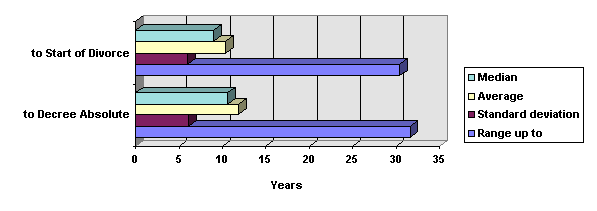
Figure 2.4 : Duration of the marriage (in years)
Comments : marriages in the survey were long term commitments, with an average of about 10 years up to about 30 years. The difference in the durations i.e. from start of divorce proceedings to decree absolute also gives data for the time taken to divorce. Based on the median this is 1.63 years, and based on the average this is 1.53 years.

Figure 2.5 : Age at start of divorce proceedings (in years)
Comments : the median of nearly 40 years, with a small standard deviation of less than 7, shows that the ages close to 40 years are a dangerous time for a man in a marriage.

Figure 2.7 : Age of children at start of divorce proceedings (in years)

Figure 3.1a : Those who petitioned

Figure 3.1b : Grounds used

Figure 3.1c : Grounds used against men and women (and numbers who denied)
Comments : approximately 3 times as many women petitioned for divorce as men. The unreasonable behaviour grounds were used in more than two-thirds of cases. Most men denied the allegations, although few women denied them, as reported by the man responding. An interpretation of the data for grounds and denial is that it was unnecessary for women to deny, while men found it necessary in order to defend themselves. The Family Law Act 1996 will remove the need even for a woman to commit perjury by making concocted unreasonable behaviour allegations as the FLA 1996 introduces formal divorce-on-demand formerly achieved with the perjured unreasonable behaviour petition. The last remnants of any hurdle to divorce will therefore be removed.

Figure 3.3a : Defending, not defending and cross petitioning
Comments : the vast majority of divorces were undefended, and a large proportion were undefended because of the solicitor’s advice. This has occurred despite most men denying the allegations made.
2.2 Children
After a separation, the home and other issues in the upbringing of children need to be resolved.
It is true that there are fathers who walk out and desert their wives and children, and don’t wish to see them again, and do not even help to support the children. But this happens infrequently.
Most cases of divorce involve the wife deserting her husband, and in fact often expelling him from his home, so that she can continue to live there. The father is therefore deliberately excluded from his children’s lives. In a significant number of cases the father is cut off completely, and in most cases there is some obstruction to contact.
Should the father wish to remedy these problems, he has only the law to turn to, with an application to court under The Children Act 1989. Children’s wishes may be listened to, when they are older than about 14 years, but younger children have no say in their immediate future.
Solicitors and barristers will usually wish to see the children with their mother. Even when the children are older, solicitors are reluctant to represent any action against their mother.
The relevant orders in section 8 of The Children Act 1989 cover residence (was custody), contact (was access), specific issues (any specific matter) and prohibited steps (preventing some action as in an injunction against someone). When a parent goes to court under The Children Act 1989, a Court Welfare Officer (CWO) is appointed to collect evidence, supposedly from an independent and impartial viewpoint. The CWO should see both parents, see the respective homes where the children may live, see the parents separately with the children, and write a report of the findings. The report should address the items in what is called ‘the welfare checklist’ of section 1(3) of the Act.
Parliament’s intentions with regard to separation and children are clearly stated in statute. The Children Act 1989 Section 1(1) gives the overriding ‘welfare principle’ :
When a court determines any question with respect to-
the upbringing of a child; or
…
the child’s welfare shall be the court’s paramount consideration.
Section 1(3), the ‘welfare checklist’, gives the basis on which a court shall determine residence and contact :
a court shall have regard in particular to -
(a) the ascertainable wishes and feelings of the child ...;
(b) his physical, emotional and educational needs;
(c) the likely effect of any change in his circumstances;
(d) his age, sex, background ...;
(e) any harm which he has suffered or is at risk of suffering;
(f) how capable each of his parents, ... is of meeting his needs;
(g) the range of powers available to the court under this Act in the proceedings in question.
The courts therefore have a duty to take these factors into consideration, and any allegations by a party about the other require to be investigated.
However, the courts have discretion, and in particular S.1(3)(g) gives the court great discretion to make any orders they wish. It is usually easy for a judge by manipulating the welfare principle with the S.1(3) factors to reach whatever conclusion he wishes.
There is no reference in the Children Act 1989 of the harmful effects on a child of a badly behaved mother, or to justice being served so far as the parents of the child are concerned.
But worst by far are the untruths usually told in the welfare reports, always in favour of the mother and against the father’s and children’s legitimate interests. The factual inaccuracies are such that it is impossible to say that the children’s best interests are being served, as a judge cannot make a decision in the best interests of the children, if accurate information is not available. Worse still, gratuitous offensive statements have been reported, as well as unethical statements. Unfortunately the judges usually accept the recommendations in reports, even when fathers protest in court about the inaccuracies.
If you are considered to have applied to court unnecessarily, or too often, your wife’s costs will be awarded against you. Most men give up against the overwhelming malpractices, or because the legal costs become prohibitive.
Case study
"Wife decided to back out of voluntary agreement made in Magistrates Court regarding access. Magistrates Court had only recorded ‘reasonable access to J’. Wife increasingly hostile to contact, children distressed at restrictive attitude to contact so applied for contact. Judge C totally ignoring children's clearly stated wishes made cruelly vindictive orders which he then raised at wife’s request at four subsequent hearings cutting all access within six months. Refused to restart contact, and all subsequent attempts to restore access turned down by Court. Over 40 days of Court Hearings devoted to case. I have no contact or hope of any. Wife has spent �250,000 attacking me, cost totally destroyed families finances. Ex-wife exceptionally bitter and left struggling on income support tant pis."
Statistics

Figure 4.1a : Contested custody and the results

Figure 4.1b : Resulting situation on custody
Comments : many men do not contest custody, and are discouraged to. Those that do succeed in few cases. Those men who achieved custody were more likely to obtain this by agreement than by court order.

Figure 4.2a : Obstruction of contact

Figure 4.2b : Actual contact

Figure 4.2c : Attitude of custodial parent (i.e. the mother)
Comments : most respondents reported deliberate obstruction to contact, and a significant number were prepared to go to extreme behaviour to alienate the father. Out of all 346 respondents, 27.9% had lost all contact with their children, and 30.6% reported the mother as being in contempt of a court order. No reports of mothers being prosecuted for contempt of court were made.
2.3 Financial matters
We describe in chapter 3 that it is largely as a consequence of Mr Justice Ormrod’s illegal case law decisions, later largely upheld by Lord Denning in the Court of Appeal, that fault, and the conduct of the parties, should no longer be relevant to the financial outcome of divorce.
It is necessary to describe what the outcome usually is. We consider the four items : capital assets, maintenance for children, maintenance for the ex-spouse, and pensions.
Capital assets
If there were no children, then capital assets are often split equally. In cases with children, capital usually follows the children, usually to the mother. If there are no assets, then there is an equal split, nothing to both parties. If there is a lot of assets, then there may also be an equal split as that will allow both parents to look after the children. However it seems that extremely wealthy fathers are often able to keep major assets, such as stately homes or businesses within the original family line. If there are limited assets, let’s say between �10,000 - �100,000, then the mother will get most, and at the lower end of this range, all of the assets. It is usually those men in the middle assets range, who invariably have had to earn those assets, who lose most in terms of their life savings, and this group are in the majority of cases.
Should the children return to your home some time after the separation and court case, you may think that the capital assets should be returned to you, to help with the children’s upbringing. But they will remain where they are - with your ex-wife, even though she is no longer the main carer for the children. The law has no way of re-allocating them. They will have permanently gone, even though your needs are greater than hers.
Maintenance for children
Maintenance for children will be set at a level depending on the number of children, the parent’s ‘needs’, the relative income of the parents, and the previous capital division.
If you both work full-time, a typical amount is about �100 per month per child, often twice this under the Child Support Act 1991 (CSA). If you have a larger salary, then it is considered that the children should share the benefits of that - but this also means that the ex-wife will also benefit, no matter what her previous behaviour, and even when she remarries. Her ‘new family’ will be significantly better off than her ‘old family’, i.e. with yourself, and hence also better off than any other ‘normal’ family. The amount by which she will be better off than in a ‘normal’ family is indicated by the average child maintenance of �3,120 p.a. paid over an average period of about 12 years. This will be at your direct expense. She will have been rewarded for abandoning you.
This maintenance is forced to be paid, by threat of a deduction of earnings order on your employer, and if you complain too much, e.g. by direct action, that will be dealt with be the threat of a jail sentence for contempt of court. This process will be applied, even if you have no contact whatever with your children, even if another man now acts as their ‘father’, and hence you are allowed no input to their upbringing except to part with your earnings.
Maintenance was, until April 1993, determined by a single judge in court. Since then, for those with financial ‘settlements’ after that date, the Child Support Act 1991, with the Agency operating the rules, has taken over. A fixed formula is used to determine the maintenance. The introduction of the CSA saw a massive public revolt. This was partly due to the fact that the then CSA rules did not recognise any previous capital assets confiscated for the benefit of the children. That is, the law was operated retrospectively. Hurried changes by the Government were made to forestall further protest, but the basic problems persist, and massive injustices still exist in large numbers. Happily, the campaign against the CSA continues and, thanks to determined campaigners of the National Association for Child Support Action (NACSA) the Agency is being eroded and is already a pale shadow of what it was originally intended to be. Further information is available from NACSA [14]. The Cheltenham Group places great importance on this campaign and so should all men considering marriage, as the destruction of the CSA, by removing a subsidy from divorce, will go a long way towards enforcing radical pro-family reform.
Most fathers wish to ensure that their children’s upbringing is adequately provided for. Thus, even under the most provocative of circumstances, such as are outlined elsewhere in this book, most fathers contribute. It is reasonable that a father should be assured that money contributed for the children is actually used for that purpose, and not on other things. And yet there is absolutely no mechanism in law, either through the courts or through the CSA, for money to be accounted for as having been spent on the children. A father can only check by general observation, such as whether the children are being adequately fed, clothed and housed.
Maintenance for ex-wives
If your wife did not work at the time of separation, the courts may also award her maintenance, as well as for the children. This again may be hundreds of pounds per month.
Those men who have supported their wives and families most during married life are the very men asked to make the greatest contribution after, even when their wife has abandoned them and used a fabricated petition to achieve divorce.
Pensions
The Pensions Act 1995, Part IV Section 166, provides for pension splitting on divorce. The pension, in terms of lump sum and annual payments, becomes payable by the trustees or managers of the pension fund, to both husband and wife, pro-rata as specified by the court, at the time you retire.
The guidelines given in the written law for this pension splitting are far too complicated to allow the layman to assess his liabilities. Section 166 Subsection 25D(2) quote ‘regulations’ which may be varied by a ‘prescribed person’, including the ‘recovery of administrative expenses’, and Subsection 25D(5) give details about the cases of Armed Forces personnel. It is instructive to read these subsections in order to understand that the individual cannot possibly know his liabilities at the time of marriage, and that these liabilities could be varied by unknown persons at any time.
Summary of financial matters
The usual rules in our society, that if you study hard, work hard, and so on, you will be financially rewarded, are entirely reversed by divorce.
To summarise the situation : the man who has applied himself, and contributed to our society will be penalised for his endeavours, while the woman who has done little will be rewarded. Conversely, the man who has done little will not be worse off, while the woman who has done much will keep her rewards. This is a classic ‘heads I win, tails you lose’ scenario.
It is important to remember that these principles apply no matter what the woman’s conduct. So, if she has run off with your ‘best’ friend, she will be rewarded for that. She will be even further rewarded if she has never studied or worked in her life.
Case study
"The result was that I was evicted from my home even though it was a requirement for my job: all of the marital capital went to my ex-wife. I was left with a bank overdraft and no home. But still expected to pay maintenance: my children were taken to live 100 miles away and I have not been able to know them: I have no continuing legal interest in the marital capital which is now shared with another man (co-habitee). I am still required, by law, to maintain a 17-year-old, a 20-year-old and a 23-year-old. All three appear to have struggled academically and none wishes to see me."
Statistics

Figure 5.1a : Money brought into the marriage by men and women (in �s)

Figure 5.1b : Distribution of assets to men and women (in �s)
Comments : men brought more assets into the family at marriage, and women left with more assets at divorce, in each case by a factor of about 5. Women as a group received about four fifths of the family assets in total after divorce. Typical cost to the family of divorce is several tens of thousands of pounds.

Figure 5.2a : Percentage of all cases who pay maintenance to children, and percentage of those previously married who pay maintenance to ex-wife

Figure 5.2b : Maintenance paid per month (�s)
Comments : most maintenance is for children, although when women do receive maintenance, it is about 50% more than that for 1 or more children. Most men provide maintenance for their children, even when they have been divorced and dispossessed of their life savings.

Figure 5.3 : Legal costs of all proceedings for men only, and of divorce only for both parties
Comments : legal costs for divorce and other proceedings are typically measured in tens of thousands of pounds, which is obtained from family assets.

Figure 5.5a : Who left the home, and by what means
Comments : in nearly half of all cases, the family home was sold. While more men left the home, much more often by court order, those men who stayed in the home were more likely to keep that home than sell it. Women given the home ‘in the interests of the children’s stability’, often sold the home and moved on. In many cases the woman leaves with the children.

Figure 6.1a : Number who applied for legal aid

Figure 6.1b : Percentages of those applying for legal aid who obtained
Comments : women are approximately twice as likely as men to obtain legal aid, and so be able to afford solicitors and barristers.
2.4 Damage to health and career
Many men are reluctant to admit to their friends, neighbours and work colleagues that they have come off badly from their experience. Those who do mainly report stress related health problems, and damage to career. A recent report [13] by Wendy Charles-Warner, a member of FNF National Council, reveals significant levels of stress as a result of separation from children together with feelings of helplessness.
However, newspaper reports appear almost weekly of cases of murder and suicide, by men who are driven beyond the brink.
Case study
"The whole business is very sad and emotionally and financially draining.
In the first few months of my divorce, I lost my then newish job entirely due to an inability to work.
The loss of my children and home are still part of my everyday thoughts after six years. I have not been able to devote myself to re-establishing my career or my personal life because I still feel, and indeed I am still mourning, my losses. Maintaining contact has been terrible. I am not entirely convinced that fortnightly contact followed by driving them back to their mother’s house in order to give them back is the way forward for the hurt party.
In my opinion, joint custody should mean that. I believe full-time care should be accorded each parent, ie six months at a time with access to the other parent."
Statistics

Figure 7.1 : Levels of stress
Comments : the great majority of men respondents suffered health and career problems, expressed as stress with associated problems. Given the scale of these problems, it is unusual that General Practitioners who gain first-hand accounts of these problems, and the other medical professionals, have not addressed this in terms of an epidemic.

Figure 7.2a : Subsequent attitudes to women

Figure 7.2b : Subsequent attitudes to the law
Comments : attitudes are direct and hardened towards those agents that have caused the damage to the lives of the respondents.
3.1 The origins of ‘no fault’ divorce
Until 1948 fathers involved in cases of separation and divorce were provided with appropriate rights over their children. In that year, in the case of Allen in the Court of Appeal, case law determined that the mother should have absolute priority. Mr Allen’s case was particularly disturbing, as he returned from the Second World War to find his wife living with another man. He contested custody of the children up to the Court of Appeal, only to find that his wife’s adultery was no bar to her priority. The lower courts have since similarly applied the same principle i.e. that custody is to the mother, no matter what her behaviour. The ‘law’, if we can call it that, regarding children has been made by judges rather than by Parliament. In fact Parliament and the public were not consulted, or even informed.
In 1973, further reforms were made by a senior Family Division judge, the then Mr, later Lord, Justice Ormrod. The reforms were made in case law decisions, supported by the Court of Appeal judges, most notoriously by the then Master of the Rolls, Lord Denning, sitting with LJs Phillimore and Roskill, in the case of Wachtel v. Wachtel. Again, these reforms were not passed by Parliament, and again Parliament and the public were not consulted, or even informed. The reforms were reinforced by the introduction in 1976 of what is called the ‘special procedure’ to ‘rubber stamp’ and so speed up the processing of uncontested divorces. The reforms are described, and supported, in Sir Robin Dunn’s book Sword and Wig [4], and the preceding history is given in The Hook and The Sting - The Legal Mafia [11].
The relevant sections of the written law at that time were in the Matrimonial Causes Act 1973 which gives the grounds for divorce, and directs the courts. Part I Section 1(3) states :
On a petition for divorce it shall be the duty of the court to inquire, so far as it reasonably can, into the facts alleged by the petitioner and into any facts alleged by the respondent.
And the Matrimonial Causes Act 1973 Part I Section 25(2), as amended by the Matrimonial and Family Proceedings Act 1984 Part II Section 3 giving a revised Section 25 of the 1973 Act, in dealing with allocation of finances, states that :
the court shall in particular have regard to the following matters- (a) ... (b) ... (g) the conduct of each of the parties, if that conduct is such that it would in the opinion of the court be inequitable to disregard it.
The case law decisions which ignored these reasonable laws were based on the premise that the outcomes of divorce should have nothing to do with the behaviour of the parties, as judges should only be concerned with the consequences of divorce and not the conduct of the parties, even though this principle had never been applied before. It had already been established in 1948 that the woman should have absolute priority over children, even though for hundreds of years previously this was not the case. No one, other than a few other senior judges, was consulted about these decisions. Ormrod’s case law was directly contradictory to the written law. As such it is considered illegal. Few people would agree to the new principles, but of course no one was informed, neither Parliament nor the public. All of the judges in the lower courts, who have followed these reform principles ever since, are also considered to be acting illegally.
We therefore have a constitutional issue to address, about control of the judges of the UK.
This history explains why many men, who are innocent of substantive wrong, are having their lives wrecked by matrimonial law. The lower courts now regularly apply the no fault principle, and the principle has even been incorporated into the written law in the Family Law Act 1996. On the basis of the public debate during the passage of the Bill, few MPs understood the issues when they voted for this Act.
It is notable that there has been approximately 35 Acts of Parliament relevant to matrimonial and family law passed from 1967 until 1997.
An important aspect of this situation is that the rights and responsibilities of men within marriage are not written down in one law or even set of laws. They may only be discovered by much study of matrimonial case law. However, our constitution clearly currently allows judges to vary the law without Parliament’s permission, so that any man who has succeeded in discovering his rights and responsibilities may find them varied at any point during his marriage. So there is no way that a man may know that the conditions he accepts at marriage will be maintained during his marriage, or during his fatherhood.
That such fundamental aspects of men’s lives are determined in such an unregulated manner is quite unacceptable in a so-called civilised democracy.
3.2 Women know they can do anything they wish
A married woman has considerable resources available to her to get rid of a husband. One of the resources is that of her husband’s life savings. The legal processes will cost thousands of pounds, in some cases many thousands. Women usually use these life savings enthusiastically.
It is a very frightening prospect to see your ex-wife spending your own life savings on legal bills, without restraint, in order to dispossess you of your children, home and life savings.
Just as bad are the lies told. Women are enthusiastic and capable liars. Most lies, to affect the outcome of the case have to be made under oath, either in affidavit (a sworn statement), or in court. This is the criminal offence of perjury, yet it is usually entirely condoned by the courts.
The level of proof for any evidence, is that of the ‘balance of probabilities’ rule which applies to civil law cases, and not ‘beyond reasonable doubt’ which applies in criminal rules. Although the outcomes of divorce are usually more severe than being the victim of most criminal offences, the burden of proof is lower. Any lie from a woman is therefore usually accepted as true.
As well as commiting perjury, women often ignore court orders, so that even when a father has an order protecting some of his and his children’s rights, these are often ignored. When court orders have been made, to ignore them is the criminal offence of contempt of court. Again this is condoned in women.
The sanctions available to judges for perjury and contempt are fines and jail sentences. The judges often will not fine the mother, as she has either not enough money, or the excuse is that it would damage the children to remove some of the mother’s finances. Jail is likewise ruled out as the children will ‘need their mother’, even though there is a father to look after the children.
It is strange that someone who has lied, committed perjury and maybe contempt of court, and benefited from these activities, should be seen as a better parent. It is also strange that criminal activity may be allowed to benefit someone. There is a tenet in UK law that no one should benefit from their criminal activity, however this does not apply to women in these circumstances.
Case study
"My children have been brought into all proceedings by their mother despite all efforts on my part to protect them.
I have been slandered and she has perjured herself in sworn statements. I intend to ask the police to prosecute her for the false allegation of forging her signature on a mortgage application.
She has deliberately ignored Court directions and yet no-one except me seems to care. I thought Court Orders and directions were there to be obeyed.
My son has been referred to a child psychologist by a divorced, part-time doctor, who is a friend of my ex-wife’s. This doctor failed to respond to my letters on my ex-wife’s Solicitors instructions. Absolutely disgusting behaviour and underhand. I complained to the Somerset FHSA, met with them and nothing was done except that I was assured that in future my letters asking for details of my son’s health would be answered.
The female mafia will stop at nothing and hurt anyone, including their own kids, and get away with it!"
Statistics

Figure 6.4a : False accusations made by women against men

Figure 6.4b : Compliance by women with contact orders
Comments : women frequently do not comply with court orders, twice as often as they comply, and yet no action is taken against them. Women are placed above the law, as perjury and contempt of court by women are largely condoned by the courts.
3.3 The judges and others who should protect men
Judges, ignoring the written law, and Parliament’s principles in that law, and so acting illegally, are clearly not protecting fathers and children. How this situation came about is largely the result of the activities of judges. Directly affecting the situation are the case law decisions described in section 3.1, but there had been previous influences which have contributed to the degeneracy. The previous history, involving the considerable influence of Lord Denning, is described in The Hook and The Sting - The Legal Mafia [11].
But others are also compromised in this situation, as judges do not act alone. The position of lawyers in this process requires to be identified. They are, as a body, failing in their duty of care to men and fathers. It is a lawyer’s role to ensure that his or her client has the law upheld, and takes actions in the client’s interests. Both solicitors and barristers are failing in this. If they were to have acted correctly, especially during the important Court of Appeal case law decisions which have corrupted the law, the present situation would not have come into existence. In other words, there is no corrective mechanisms in operation. Similarly, Court Welfare Officers are not controlled effectively.
The evidence for this viewpoint is the large amount of anecdotal material from those who have taken complaints. Some men, and there are about 15 known, have taken their cases to the European Commission/Court of Human Rights. Even here, almost unbelievably, the judges have turned down almost all cases and have refused to give any reasons, even though their own Rules of Procedure, i.e. Rule 52(2), require them to provide reasons for any decision.
Those fathers who have described their cases to their MP usually get lip service and no more. MPs appear not to want to know. We can illustrate attitudes and actions with an anecdote. Glenda Jackson MP was provided with briefing material in 1994 which described the treatment of fathers under family law. In reply, she wrote a letter to Families Need Fathers, dated 15 July 1994, saying that she found the paper "an attack on women". Not only had she refused to act on the information given, but she accused those who had given her that information of "attacking women". Most men are not rebuffed in such a way, however they are told by their MP that it is not possible for an MP to interfere in legal cases, which is true, or that they should appeal, which is impractical and highly unlikely to resolve anything, or that nothing can be done, or some other obfuscation.
We can illustrate the behaviour and attitude of solicitors with an anecdote. In March 1996, John Cornwell, the then Chairman of the Solicitors Family Law Association (SFLA), which represents solicitors who specialise in family law, was a guest speaker at the Families Need Fathers AGM, then held in the Polish Club in Kensington. He is arguably the most senior solicitor in family law in the UK.
While, over lunch, discussing the divorce situation that men face, he pointed out that in the 1920s and 1930s, a woman who committed adultery, could be divorced by her husband, and would receive nothing in assets from the husband. Many would say that was a fair and reasonable practice, unless some misconduct was proved on the part of the husband. John Cornwell considered that situation "appalling and dreadful". It was pointed out to him that if a woman commits adultery in the 1990s, it is the husband who receives nothing. He was then asked which situation was the more "appalling and dreadful" : he made no comment. We have to consider the sense of justice of a person making such a statement, and when we do this we should remember that this was the opinion of the Chairman of the SFLA, who could be regarded as the most senior family law solicitor in the UK.
During his speech, he declared that fault or conduct in matrimonial cases was clearly "not judiciable" i.e. that it was not possible for a judge to determine who was at fault. He considered the conduct of the parties, and argued that in a history of conduct by the first party, that there was usually some previous conduct of the second party, which was preceded by yet other conduct by the first party, and so on, until we find trivial matters such as leaving the top off the milk bottle. He argued that judges could not discern who was originally at fault. But he did not consider that some conduct is significant and substantive, while other conduct is not. He therefore did not distinguish cases of substantive fault, e.g. adultery, and cases of trivial or less obvious fault. He said that fault should be dropped. Given the consequences of a badly behaving wife, that no judge can determine this is a serious matter. He didn’t consider that if the judges are incompetent, then we should sack them, and replace them with competent ones, just as in any other profession.
Access to the law is determined largely by what you can afford. More women apply for, and more of those obtain legal aid. Approximately twice as many women obtain legal aid as men.
To summarise, we have a situation which involves judges acting illegally, Parliament’s principles being ignored, married men being unable to determine their rights and responsibilities in matrimonial law, and that these rights and responsibilities may be altered at any time by judges, without agreement or even consultation. In addition, malpractices by lawyers and Court Welfare Officers go entirely unchecked.
In order to allow the current malpractices in matrimonial law to continue, it has been necessary for the judiciary to ignore the following :
the written law, and Parliament’s principles;
the rationale for having a written law i.e. that everyone may readily know the law, and that it shall not be varied arbitrarily;
the tenet that no one should benefit from their criminal activities;
the tenet that there should be one law for all;
international human rights law.
Case studies
About solicitors :
"Solicitors cause most of the problems and charge extremely high fees for little knowledge and yet even with a sensible service can still be paid. The whole system stinks. The Judges are biased and generally go along with the adversarial Barristers in the game show of the Court room where each Barrister is only interested in outdoing the other Barrister.
My divorce process still isn’t finished completely after five years."
About barrister :
"I sent a formal complaint about my counsel and her professional conduct to the Executive Secretary of the Professional Conduct Committee, General Council of the Bar."
About Court Welfare Officers (CWOs) :
"However, my experience of the Court Welfare Officer is very bad. He was very sexist, biased and lied in his report. This forced me to withdraw proceedings to seek custody of my daughter. This particular report gave my ex ammunition to block all contact and I have not seen my daughter for two years. I have complained vigorously to various Bodies re the CWO. I have received an apology from the Regional Director from Probation Service. He expressed deep regret, but this is no use as the damage is done."
About judge :
"When I surmount my immediate problem I would like to campaign to:
(i) Get District Judge B removed from office.
(ii) Help to ensure the proposed reforms of Divorce Laws are indeed reforms.
(iii) Make judiciary accountable and responsible to the community."
Statistics

Figure 6.2 : Malpractices in the legal system
Comments : the malpractices are regularly reported in anecdotal evidence. These figures illustrate the scale of the problem. Many men progress their case with an inadequate knowledge of the legal system, often relying on lawyers. They hence are not aware of what should have happened in the case, and so are not in a position to report the malpractices in their case.

Figure 6.3c : Opinions on whether report was fair or unfair

Figure 6.3d : Whether judge accepted CWO’s recommendation (whether fair or not)
Comments : there is immense bias in CWO reports, and most are considered to be unfair. It is very unusual for a judge not to accept a CWO’s recommendations.
3.4 State support for lone mothers
Should a woman decide to have children without a husband, or to dispose of a husband after having children, the state offers that woman every incentive and support.
In the leaflet Bringing up Children ? [20], from the Benefits Agency, the benefits relevant and available to lone mothers are listed. These are funded by the tax-payer, except for Child Support Maintenance from the natural father. The separate benefits are listed under the following headings :
Child Benefit
Family Credit
Disability Working Allowance
Jobseeker’s Allowance
Income Support
Free and reduced-price milk
Housing Benefit
Council Tax Benefit
Caring for someone - Home Responsibilities Protection
Help with health costs (7 sub-headings)
Help with extra needs (6 sub-headings)
Tax and the lone parent family
Looking for work ? (National Insurance contributions rebate for employers)
Child Support Maintenance (NB - from the natural father)
Widows with children (2 sub-headings)
Expecting a baby ? (6 sub-headings)
Children with special needs (5 sub-headings).
The support provided is such that most trappings of modern life are available without the woman having obligations or responsibilities towards others, including towards the children’s father, to society generally, or any obligation to earn these benefits in any sense. And women know this before having children.
Many of these benefits are available only to the ‘parent with care’, invariably the mother, but not the ‘absent parent’, who as we note elsewhere should more correctly be referred to as the ‘excluded parent’. This applies even when the ‘excluded parent’ is caring for the child(ren) for a proportion of the year, and so should receive a proportion of the benefit if the child(ren) are in reality to benefit from the support. Child Benefit is one example. Similarly there are benefits and taxation rules for widows, which are not available to widowers, including a widowed mother’s allowance. In early 1998 this situation is subject to applications which may remedy these anomalies including applications to the European Commission/Court of Human Rights [16].
In addition to Social Security benefits, taxation rules support lone mothers. The rules in fact give priority to lone mothers over normal families. It is shown in Farewell to the Family ? [19] that lone mothers have a greater net income after taxation than a normal family for every level of gross income. The father who supports children and a wife has less in his pocket after tax than a lone mother who supports only children. It is remarkable that the lone parent lobby is heard more often than the normal family lobby on this issue, but this is due solely to the organisation and representation available to the lone parent lobby [5].
The major aspects and issues which arise from current benefit and taxation policies are :
that massive state support has seriously undermined the role and rights of men within the family, to the extent that it may be said that the state has replaced the man’s role in many areas;
the benefits and taxation system provides lone mothers with a better standard of living than a normal family for every level of gross income, thus giving an incentive to this lifestyle;
there are benefits and taxation rules giving preferential treatment to widows compared with widowers.
The state support outlined above is common knowledge amongst women’s groups, and provides women with a ‘lifestyle choice’ as they may live comfortably without obligation or respect for the rights of others, particularly the fathers of ‘their’ children, and without even earning a living. This ‘lifestyle choice’ is not available to men.
3.5 Liberal attitudes and radical feminism
Liberal attitudes and unrestrained feminism have permeated our culture during the last 30 years. This is well described in Discrimination Against Men in the UK, United Kingdom Men’s Movement (UKMM), 1995 [5].
The bias in welfare reports is well documented [2], but what is not so well known is the official approval given to this. Welfare officers are part of the probation service, whose trade union and professional body is the National Association of Probation Officers (NAPO). In NAPO’s policy document Equal Rights / Anti-sexism of September 1996 [15] we find, in the section on ‘Policy Objectives and Targets’ for ‘2. The Family Court System’, the following :
(a) To develop and promote policies and strategies which strengthen and enhance the ability of women to make and carry out choices within separating families.
(b) To develop and implement policies and strategies which challenge the experience of oppression of women in separating families.
(c) To support the rights of lesbians as mothers and carers.
(d) To develop policies and strategies which challenge the discrimination against women in contested residence and contact decisions.
…
(f) To develop and promote training strategies which strengthen the anti-discriminatory perspective of family court work.
We leave it to the reader to consider for him/herself the effect of such a policy operated within an already corrupt system of court welfare work, and the nature and effect of the ‘training’ which they refer to in item (f).
The activities of female lawyers are revealed within the anecdotal evidence of the case studies [2], and they bring their chosen profession into great disrepute.
But it is those feminists, including lawyers, who have obtained positions of influence who are most culpable. There is none more so than Brenda Hoggett, now Dame Brenda Hale. Once an academic lawyer, she obtained a position on the Law Commission responsible for drafting of family law reform, and is now a High Court judge under the name Mrs Justice Hale. In 1980 she wrote [6] :
"Family law no longer makes any attempt to buttress the stability of marriage or any other union. It has adopted principles for the protection of children and dependent spouses which could be made equally to the unmarried. In such circumstances, the piecemeal erosion of the distinction between marriage and non-married cohabitation may be expected to continue. Logically we have already reached a point at which, rather than discussing which remedies should now be extended to the unmarried, we should be considering whether the legal institution of marriage continues to serve any useful purpose."
Notice that she skilfully manages, within one paragraph, to convey the impression that family law has somehow just changed, as if that were inevitable, and that the change can’t be undone. Also that the "protection of children and dependent spouses" is all that matters, and that this "protection" should be extended to those who have never agreed to be bound by any marriage. But further, that marriage is now irrelevant, as "we should consider whether the legal institution of marriage … serves any useful purpose".
While this book was being written, ‘Mr T’ was obliged to apply for leave to appeal to the Court of Appeal (CoA). One of the two judges at the hearing was Mrs Justice Hale who was temporarily acting in the CoA. ‘Mr T’s’ ex-wife had previously obtained a clean break, obtaining all of the equity in the home. She had returned to court two years later asking for a 40% rise in maintenance for the children. The County Court Judge granted her this request, and so ‘Mr T’ applied to the Court of Appeal to have this unjust judgement reversed. Mrs Justice Hale told ‘Mr T’ that he could not have a clean break from his children. ‘Mr T’ had been forcibly separated from his children, and did not want any ‘break’ from them in any way whatever. It is considered that Mrs Justice Hale’s statements in court are as offensive as they possibly could be in the circumstances, and demonstrate her real beliefs and motivation in family law issues.
In an interview for The Daily Telegraph of 1 October 1996 [18], about 6 months before the forthcoming election at which Labour were elected with a landslide, Janet Anderson, the Labour MP for Rossendale and Darwen, gave the clearest possible statement of intent when she said that :
"Under Labour, women will become more promiscuous. That’s an election pledge."
Attitudes towards, or rather against, marriage are frequently heard on the media. As an example, two Cheltenham Group members appeared on Radio North on 20 October 1997, with Sarah Buttle of Women On The March. Sarah Buttle said, during the item :
"I personally think that marriage is an outdated idea."
Young men, and the public, on hearing comments of this nature, made against the current background situation of fewer marriages and more divorces, may find such comments innocuous. We need however to understand the reality. What such women’s groups are promoting is the ability of women to have affairs and relationships with men and to have children with these men. But not to offer assurance to these same men of any involvement with their children’s upbringing, and further however to ensure that they continue to benefit from the same men’s future income. In other words to use these men to have the children they wish for, but offer these men nothing in return, and even to ensure they benefit from the man’s future earnings and without obligation or responsibility towards the man. If we say that this is the real agenda of such women’s groups, we mean that they wish to ensure the continuation of this situation, as this is the reality they already enjoy.
Marriage has been the contract which has given men rights, and the social convention which separates us from the beasts of the field. To remove it would revert our society to some sort of primitive form in which men cannot invest in their home and children safely - just the situation we now see as a result of the comprehensive corruption in matrimonial law. We see the consequences of this marginalisation of fatherhood all around us in the form of the rising crime, emotional and educational breakdown, addiction, illegitimacy and all the other social pathology now unquestionably associated with lone motherhood. While we concern ourselves here with personal injustices to a large number of men, the problems created by radical feminism in its attack against the family are threatening the stability of our society. In opposing these evils, therefore, men will not only be protecting themselves but acting truly in ‘the best interests of the children’ by restoring the rule of law to a disintegrating society.
3.6 The inactivity of men
The great majority of men facing the problems described in this book have accepted the situation without complaint or challenge. Most have not even joined the well known father’s groups. If they had joined such groups, they would have created a force which would readily obtain political change.
But the experience of those who have attempted to obtain remedies to the malpractices identified, and have dealt with authority and those bodies responsible for the correct operation of the legal system, e.g. The Law Society, HM Inspectorate of Probation, the Lord Chancellor’s Department, etc., is very negative. Essentially these bodies are not interested and will go to considerable lengths to avoid the issue and their own responsibilities.
However, some determined men have done all in their power to address the problems, including in their own case, and hence correct the problems. Notable amongst them are :
Oliver Cyriax [7] for exposing the corruption in the Court Welfare Service;
‘Joe Public aka The Ringer’ [10] for exposing the complicity of lawyers and judges in his case;
Dr Michael Pelling for taking his case to the Court of Appeal and to the House of Lords during 1996 about the secrecy of the courts, and then in early 1997 taking the case on to the European Commission of Human Rights (ECHR) against the UK;
the Cheltenham Group for making a submission [12] during 1995 to the United Nations Human Rights Committee, Geneva, about the many violations of article 23(4) of the UN International Covenant on Civil and Political Rights (ICCPR) by the UK; this article is supposed to guarantee equality of rights and responsibilities of spouses during and after marriage;
Christopher Crossland, with the support of Liberty [16], for taking his case in 1997, concerning the bereavement tax allowance given to women but not to men, to the European Commission of Human Rights (ECHR) against the UK;
the Child Poverty Action Group, for supporting [16] a case in 1997, concerning benefits (i.e. widow’s payment, widowed mother’s allowance and widow’s pension) available to widows but not widowers, to the European Commission of Human Rights (ECHR) against the UK;
and the fifteen men known to have applied to the ECHR, about the violations of the European Convention by the UK’s matrimonial legal system and family policies.
We regard these men, in taking these steps in what has usually been the most difficult of circumstances, as amongst the heroes of our time.
An obvious question which arises when confronted with the information in this book is ‘why have so many men put up with so much abuse for so long ?’.
We do not think that there is a simple or single answer to this question, but it is an unfortunate fact that a great many men have accepted the greatest losses and have done nothing whatever about it. We may only speculate that the reasons for men’s inactivity include :
their low morale;
they have known no different, and cannot imagine anything better;
they have had no effective leadership.
4.1 Avoiding the issue
One simple piece of advice is not to get married, and not to become a father. This may not of course be acceptable to everyone, as many men have ambitions to found a family and raise them in a manner which they consider best. If you do marry, then ensure that your wife continues to work and contributes equally towards the family and her own pension. That way, if she deserts you, at least she will have had to earn any monies she receives. If you have children, then ensure as far as you can, that you equally control the process of having children, and in particular, ensure that she understands that she does not own the children, and that you have at least an equal say in their upbringing.
4.2 Going to law
Should you become involved in the problems described in this book, and need to go to law, then advice is available.
Basic advice on practical and legal steps includes :
don’t leave your home, and if your wife insists that she can’t live with you, then ensure she leaves, not yourself;
don’t become separated from your children, as this will allow such a ‘status quo’ to be used against you;
don’t trust any lawyer, act for yourself as a ‘Litigant in Person’ after getting further advice about legal procedures;
don’t accept a fabricated divorce petition against you, if you get one, then defend the divorce and cross petition;
apply to court without delay for a residence order for the children;
if a welfare officer becomes involved, then make it clear you will not accept an inaccurate report, in fact threaten the officer with the complaints procedure if s/he does or says or writes anything untrue or unprofessional;
in court, always insist that the judges follow the written law, and make sure that it is quite clear to them that you will make a complaint to the Lord Chancellor’s Department, via your MP, about any malpractice on their part;
always ask for a penal clause to be added to an order, which may be used against your (ex-)wife should she ignore a court order;
report any case of perjury by your (ex-)wife immediately to the police and ask them to bring a prosecution under the criminal law.
If you run into the problems described in this book, always remember to ask about, and use, the complaints procedures available. This applies to solicitors - the Solicitor’s Complaints Bureau, barristers - the General Council of the Bar, Court Welfare Officers - Area Probation Committee then the Home Office. Complaints about judges should go to the Lord Chancellor’s Department, preferably via your MP. When you take complaints to the responsible authorities, always ensure that they understand that you will take the matter further if they do not deal with the issue correctly. Leave them in no doubt about your determination or your ability and resources to do that.
Always keep your MP fully briefed about your case, and ask him to take up issues with the appropriate government department for you.
Publish details of your case as widely as possible in the press and media. However, be careful about the laws of libel and slander. Libel law can be used against you by other people : you may be sued for libel if you say something about an identified person, which is untrue and which causes them harm. Unfortunately this law is preventing the truth coming out, as there is always a danger that if you truthfully publicise someone’s activities they may be able, by using a good lawyer, prove you not to be telling the truth. An excellent example of publicity about malpractices in an area court welfare service has been produced by Oliver Cyriax [7].
Finally, there is further advice available from other groups, notably Families Need Fathers (FNF). FNF publications [8] are readily available.
The United Kingdom Men’s Movement (UKMM), and its affiliated group Dads After Divorce (DADs) can also offer advice to help you not to be misled by your solicitor and can put you in touch with organisations which advise litigants-in-person should you decide to act for yourself.
There is no doubt that the interpretation of divorce law violates articles of the European Convention on Human Rights, especially article 6 (guaranteeing fair hearings), article 8 (respect for family life), article 14 (sex discrimination), article 1 of Protocol 1 (enjoyment of possessions) and article 5 of Protocol 7 (equality of rights and responsibilities during marriage and at its dissolution). It is noteworthy that Protocol 7 is not currently ratified by the UK. Also in the UN International Covenant on Civil and Political Rights, ratified by the UK in 1966, Article 23 Clause 4 requires that governments "…shall take appropriate steps…to ensure equality of rights and responsibilities of spouses as to marriage and at its dissolution". The UK has quite clearly failed to implement Article 23 Clause 4.
All of this may seem to indicate that an application to the European Commission/Court of Human Rights may be worthwhile. It must be stated however that the experience of this is not good. The ECHR treats the written articles of the convention with the same contempt as that with which our own judges treat UK statute law and are just as obsessed with ‘political correctness’. This means finding in favour of women regardless of the written law and interpreting ‘equality’ to mean favouring women. Given the size of the undertaking in going to Strasbourg (all domestic remedies have to be exhausted, meaning probably a failed appeal to the House of Lords) it seems that this action offers no realistic remedy. You do, however, have the right [9] of individual application to the Strasbourg Commission and some in appropriate circumstances may choose to bring test cases.
With the case of Van Raalte v. The Netherlands [17], the European Commission/Court of Human Rights has made judgement on 21 February 1997 on an issue of family policy involving sex discrimination against men. This case provides some slight optimism that men may obtain some rights at ECHR.
Dogged perseverance under UK law seems to offer the best hope and provide the best impetus for reform. Above all, if you are persecuted by the divorce industry, fight, and never give up. Organisations like the Cheltenham Group will be behind you, helping with advice and exploiting our ever-increasing media coverage to give you favourable publicity. This way you may very well win significant rights, as have many members, you will be sending the powerful message to your children that you did not walk out on them and you will be helping to exert massive pressure on the establishment for radical family law reform to rid our society of this problem altogether.
4.3 Public relations
The public are generally ignorant about matrimonial law. We need to inform and educate them about what is going on. Tell everyone what you’ve learned from this book, tell them what you think, tell them you’re not going to put up with men being treated in this way. Tell your friends and neighbours. Tell your boss. Tell your girlfriends especially, in case they think that you are likely to accept such treatment : make certain they know what they are asking you to accept, if they contemplate marriage to you. More importantly, inform the press and media. Tell you local press and radio station. Tell the national press and media. Tell it wherever you can.
We now have available, from the Cheltenham Group and others, excellent publications which describe the situation. As an example, the book Article 29 Magna Carta 15 June 1215 Runnymede [10] gives the case history of one man. The references give full details of the most important publications.
But public relations is not only about information. It is also about attitudes, about public policy in terms of finance and law. It will be necessary to convince the public that there are better ways. This relates to current practices, and to control mechanisms.
And always, most importantly, ask the question ‘who is responsible ?’.
4.4 Political activity
A number of members of the father’s groups have briefed MPs, Ministers and members of the House of Lords, including some Bishops, both about their own cases, and about the situation in general. Almost all approaches are met with by ‘smoke screens’ and bluster that nothing is significantly wrong, or that the case is not typical. All of those briefed have consistently refused to act to remedy this situation, even when they have been confronted and presented with the clearest possible evidence. Not one MP or Minister has taken the decisive action which will be needed to expose what is going on or to remedy it.
As one example, on Thursday 31st October 1996, Cheltenham Group representatives met with Gary Streeter, a Minister in the Lord Chancellor’s Department, to brief him about the situation in matrimonial law. Mr Streeter had, prior to the meeting, received a copy of The Emperor’s New Clothes : Divorce Process and Consequence, with that book’s description of current malpractices, supported by the dossier of 138 cases studies, and the comprehensive statistics. Mr Streeter’s response was that the book related only to those cases that were ‘on the margin’. He invited the Group to submit evidence that the cases were typical. Again, a Minister had avoided the issue, even when presented with hard evidence, and which was at that point, the best collection of evidence available.
We should not let this present deliberate lack of interest by our MPs etc. prevent us from making sure that such people are fully briefed. Make sure your own MP knows what is going on, and that you will not tolerate it any longer. Make sure your MP knows that votes are at stake if he fails to act correctly. There is a growing apprehension among the establishment concerning the growth of an organised men’s movement with a sound intellectual base, and this will increase the pressure you can apply to your MP.
We have shown that the interpretation of matrimonial law is now comprehensively corrupt and the FLA 1996 reforms will sanction that corruption in statute law. We have said little about the radical reforms needed to rid innocent men and society at large of this evil and to restore the rule of law and family stability. Every young man who follows the advice in this booklet will have the added satisfaction, that by refusing to submit to politically motivated persecution, he is helping to enforce radical reform.
The Cheltenham Group, as well as other groups, is dedicated to reforms which have as their central theme the abolition of ‘no-fault’ divorce-on-demand. Conduct will be restored both to the grounds for divorce and the financial and parental consequences of it. No spouse, therefore will be able to deprive the other of his/her home or children or any part of his/her income unless substantial and objectively defined grounds can be proved. Other aspects of the reform include such matters as the repeal of the Child Support Act, the reinterpretation of ‘children’s rights’ and the restoration of sexual and reproductive rights in marriage. For further details contact the Cheltenham Group.
As we have shown, the problems have largely arisen not through statute law but through the malpractices in its interpretation. Reforms must therefore prevent repetition of this, and to this end the Cheltenham Group includes the following among its reform aims :
discretion in matrimonial and family cases should be largely removed from judges who will not be allowed to sit alone or in secret and whose only role should be to ensure delivery of the outcome specified in statute law;
constitutional reform should be made to make judges accountable and to prevent further corruption;
the conduct of lawyers, social workers, court welfare officers and judges should be subject to close continuous scrutiny by independent bodies with lay representation;
the men whose lives have been damaged by this should receive compensation, in order to restore their lives, and to demonstrate that legal malpractices will not be tolerated.
A vital requirement for the achievement of reform is that men organise themselves. The current situation is being sustained by a powerful combination of vested interests, including the financial interests of the legal profession, the ideologies of the social work industry and the inter-party political competition for the block female vote at the next election and all these interests are supported by the prevailing media culture which dictates ‘opinion’ to a passive, uniform public. These interests are far too great for any appeal to decency, fairness or social stability to have any chance whatever by itself of achieving the radical reform required.
It follows therefore that only the determined and sustained intervention of resolute men through their refusal to co-operate with this corrupt system will achieve the required cultural and legal changes.
All men, especially the young, with the support of those women wise enough to realise that these reforms are also very much in their interests also, must now act to remedy the current situation for their own sakes and for their children and society at large.
References : for those who wish to study the subject further
The Impact of Divorce Law Practice on Fathers and Children - The Main Findings, July 1996, and the - Supplement : Summary, Probabilities and Extrapolations, and Conclusions, The Cheltenham Group, July 1996, ISBN 1 900080 01 X.
The Emperor’s New Clothes : Divorce Process and Consequence, The Cheltenham Group, October 1996, ISBN 1 900080 04 4.
Restoring Legal Marriage, The Cheltenham Group, November 1994.
Sword and Wig : Memoirs of a Lord Justice, Sir Robin Dunn, Quiller Press, 1993
Discrimination Against Men in the UK, UKMM, 1995; Internet : http://www.zynet.co.uk/gold/lymtel/ukmm/.
Ends and Means : the utility of Marriage as a Legal Institution, Brenda Hoggett in Eekalaar and Catz (eds), Marriage and Cohabitation in Contemporary Societies, p.101, Butterworth, 1980.
The Baring System, Oliver Cyriax, 4 Cardross Street, London, W6 0DR.
Publications of Families Need Fathers, FNF Office, 134 Curtain Road, London, EC2A 3AR; Phone : 0171 613 5060.
Literature of European Commission of Human Rights, Council of Europe, BP 431 R6, F67006, Strasbourg Cedex, France.
Article 29 Magna Carta, 15 June 1215 Runnymede, Joe Public aka The Ringer, Edition 1, 1996, ISBN 0 9528267 0 4, Wotachambells Press, PO Box 1215, Thorrington, Colchester, CO7 8JD.
The Hook and The Sting - The Legal Mafia, Ivor Catt, Westfields Press, 1996, ISBN 0 906340 09 8, 121 Westfields, St Albans, AL3 4JR.
Report to the UN Centre for Human Rights on Article 23(4) of The International Covenant on Civil and Political Rights, The Cheltenham Group, 1 July 1995.
Men’s Health Survey, Wendy Charles-Warner, October 1996.
Publications of National Association for Child Support Action (NACSA), NACSA Milton Keynes, PO Box 3195, Fishermead, Milton Keynes, MK6 2YB; Hotline 01908 665646; Internet : http://www.scallywag.com/nacsa; Email : [email protected].
Equal Rights / Anti-sexism, National Association of Probation Officers (NAPO), 4 Chivalry Road, London, SW11 1HT, September 1996.
Press Release of 21 April 1997 embargoed 00.01 hours 24 April 1997, Liberty/National Council of Civil Liberties, 21 Tabard Street, London SE1 4LA.
Press release issued by the Registrar of the European Court of Human Rights, 21 February 1997.
‘Women like seeing men as sex objects’, The Daily Telegraph, 1 October 1996.
Farewell to the Family ?, Patricia Morgan, Institute of Economic Affairs, 2 Lord North Street, London, SW1P 3LB, January 1995, ISBN 0 255 36356 7.
Bringing up children ?, Benefits Agency leaflet FB27 From April 1997, available from Social Security offices and (for 5 or more copies) from The Stationary Office Ltd, The Causeway, Oldham Broadway Business Park, Chadderton, Oldham, OL9 9XD.
Index
Not available in HTML version. You may buy this book in hardcopy or disk format.